27 August 2026
Mastering Ogres Part 2: Strengths and weaknesses!
Written by
Medivo
Welcome back! So today is Part 2: Strengths and weaknesses!
This will be considering both the roster and how the team stands within the comp pack. This was supposed to update yesterday, but… I spent too much time faffing about at games night…
The Good
So, the FUMBLL breakdown is a great place to start for pretty much every team – and not a lot has changed for ogres between 2020 and 2025 editions. For tournaments specifically, they gain +1 passing on gnoblars, the Devious skill category existing as primary for gnoblars and secondary for ogres and loss of access to Old World Classic star players.
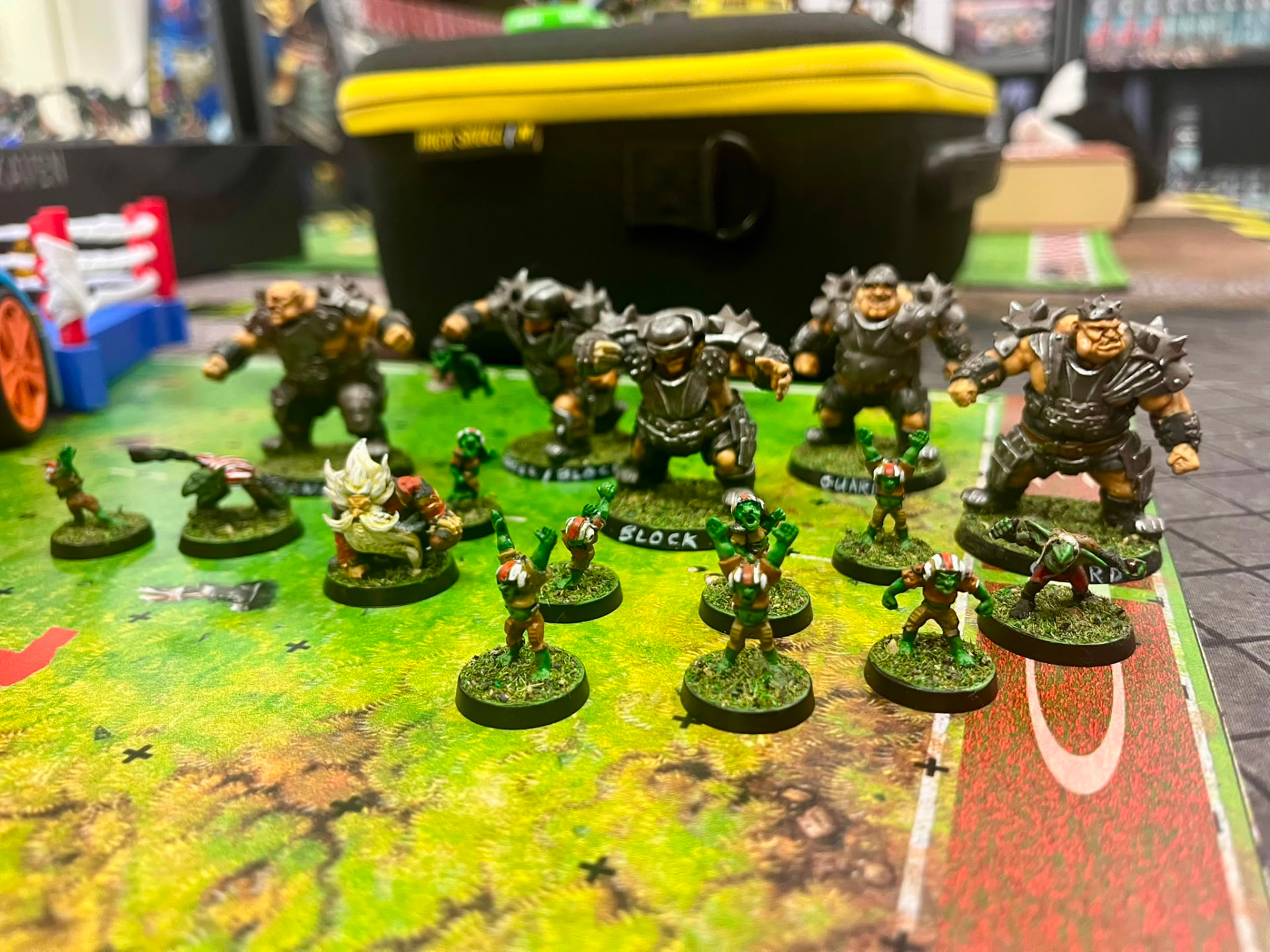
Big strength (pun intended) for the ogre team is the ability to concentrate lots of Str 5 players in one place. Only Chaos Renegades and Snotlings comes close with their big guy options. Ogres can have 6 — that is either an overwhelming mass on the Line of Scrimmage or your opponents need multiple assists just to break even for most teams.
Ogres are tough. Str 5 means it’s hard to get 2D blocks, AV 10, and Thick Skull means it’s tricky to remove them without Claws or fouling. Granted, sometimes getting back up is difficult, but that’s ogres/big guys in general.
Mighty Blow/general removal — so much removal. In terms of odds, you might as well put your opponent’s whole team at -1 AV when considering if you’re going to stun them or worse. If your players are throwing blocks, they are highly likely to be generating injuries.
Gnoblars are cheap, and very agile — they can dodge pretty much anywhere on a 2+ with a reroll thanks to Stunty, Titchy, and the Dodge skill. This lets them engage/disengage better than most elf teams early. Being only 15k means that you can take a full bench especially with this comp, meaning you don’t have to worry much about setting up for offense or defense understrength.
Throw Teammate and Kick Teammate. These are separate declarations, meaning you can do both. If you ignore the (considerable) odds, you can cover the entire pitch in a single turn. You can also sneak additional spaces of movement because the gnoblar can be placed behind the punter, and the throw/kick is counted from the space in front of them. The runt punter is the most accurate base big guy for throwing/kicking at PA 4+ — something no other team has without skills. Halflings and gnomes have 5+ and Strong Arm on a Treeman.
The ability to yeet players with or without the ball twice per turn is really useful. Just the threat of a one-turn touchdown will affect how your opponent positions, and if you manage to yeet a gnoblar into the backfield (and they survive the journey) then you can harass throwers or other positional players or just set up to receive and dash to the end zone.
It can also be used to threaten a cage. As throwing a gnoblar at a player only causes a turnover if the gnoblar has the ball, you can threaten to knock down the ball carrier or caging players. The odds of it working are slim, but hilarious.
The Bad
Ogres are unreliable. Bonehead means 1/6 of them will fail to do anything but occupy a space. No tackle zones, distracted condition. With up to 6 ogres on the team, you should expect and plan for at least one to do nothing on each of your turns. Usually the one you need to actually do the thing. I’m not going to go into mitigation here, as it will be explored in detail later, but there will be turns when your ogres function perfectly, and others where you have 5–6 useless lumps leaving a path clear to the end zone because they forgot they’re playing a match.
On the subject of ogres, they are Str 5. This is awesome — easy access to 2- and 3-die blocks with the starting roster.
However, a 2-die block with no skills has a 1/9 chance of resulting in your ogre falling over and ending your turn. Sometimes it’s the best play, but passing Bonehead and making a 2-die unskilled block has a flat failure chance of just over 25%. With both fail states resulting in your player without tackle zones — plan accordingly. (Maths from BloodBowlDave.)
Expect to see this a lot.
Gnoblars. Str 1, Stunty, AV 6. It is a good thing they are cheap, because they will be removed from the pitch, either due to being blocked into paste or getting spotted by the ref kicking an opposition player while they’re down.
Whenever you consider basing a gnoblar, make sure you accept the fact he may be about to dive straight into the Casualty box!
The ogre team begins with no ball handling skills, and a chunk of the team is unable to use the new “Secure the Ball” action. And with the whole team having MA 5, moving the ball around is difficult, or reliant on strings of dice rolls via Throw Teammate or Kick Teammate (TTM/KTM for short) to rapidly move the ball about.
The Specific
So, in this specific tournament format there are several pros/cons that are less useful for league play, or potentially even other events, but they were something I considered before working on my list.
Resurrection event — you get your guys back. In general not a problem unless you lose ogres, but this in and of itself meant I wasn’t too worried about picking up an apothecary.
Free skills. The pack gives free skills and more TV to various teams, with more goodies and more TV the less competitive a team is.
Ogres get 10, 2 of which can be secondary, and they’re allowed to spend 3 on a star player. Plus a whopping 1,200 TV of players, rerolls, staff and inducements.
In terms of star player selection, I think ogres have a strong lineup, with access to both Badlands Brawl for Orc/Goblin stars and Worlds Edge Superleague for Dwarf and some Norse stars. For this tournament, I’m leaning towards the Dwarf/Norse options, but I know of teams that look to Scrappa Sorehead.
Weaknesses of pack: lack of easy elite skills. Lots of “normal” teams get to spam Dodge/Block and I am allowed 2 copies of Block maximum. This may be a problem as it increases the relative risk of using ogres, as a 2-die block vs players with lots of Block/Dodge available becomes more risky or less likely to knock people down. Lots of Guard for a strength team may be good, maximising 3-die blocks!
I think I’m gonna leave this here. However, I aim to be back tomorrow with Day 3 — although Part 3 may be more appropriate. I may come back to this if I think of anything else.
Comment if I’ve missed anything glaringly obvious!
About the author: Medivo writes for The After Hours Hobbyist blog.